


WFSGI MAGAZINE 2025
WE NEED ACTION ON INACTIVITY, AND WE NEED IT NOW.
How the Sporting Goods industry can be part of the solution through deeper and wider collaboration.
Physical activity
From playground to podium
“Physical activity levels globally are getting worse.” and “We are off track for 2030 .”These were two disheartening headlines that followed the updated adult physical activity data published by WHO last year. The data was interpreted and summarised by WHO in their report: Global levels of Physical Activity in Adults – off track for 2030[1], which reported that globally, one in three adults (31%) are not meeting WHO’s recommended levels of physical activity which is at least 150 minutes of moderate intensity activity per week. This figure has also worsened by 5 percentage points since WHO began tracking it and is expected to worsen further to 35% by 2030 if current trends continue. In 2025, WHO is expected to publish updated data on physical inactivity levels by adolescents which currently stands at an astonishing 81%.


Put the problem in the spotlight
Despite the positive contribution of physical activity on health, education, our economy and our environment, it is not getting the profile or priority it deserves by any sector or industry and our society is missing out on the benefits. In fact, 1.8 billion adults and over 1 billion adolescents across the globe are missing out.
Now, Imagine a more active world.
What would happen if the world’s population met the recommended physical activity levels?
We would have 20-30% lower risk of death due to Non-Communicable Diseases [2]
Our public health care systems could save US$300 billion by 2030 – US$27 billion per year [3]
We would feel happier and have less symptoms of depression and anxiety [4]
Children and adolescents would benefit from healthy growth of bone and muscle and improved motor and cognitive development [5]
Young adults would benefit from greater employability skills such as teamwork, self-discipline, time management and self-esteem [6]
Our workforce would benefit from reduced staff turnover, increased productivity, reduced absenteeism and improved staff morale [7]
Our climate and air quality would benefit from reduced carbon emissions as more people walk and cycle [8]
Align our industry towards collective action
WFSGI’s mission on physical activity is to galvanise our industry to support global citizens to lead more active, healthy lives. 2024 was WFSGI’s first full year of action towards this mission, guided by the Memorandum of Understanding we have with the World Health Organisation (WHO) and it has been full steam ahead! WFSGI’s Head of Physical Activity, Caroline Brooks, after joining the team in March 2024, has driven much-needed progress in our industry’s plans to act in the context of disappointing data trends and the systemic lack of priority given to physical activity across global agendas. But there is a reason to be positive and our recent achievements look set to change the narrative and inspire and lead a movement of collective action on physical inactivity.
A joint goal unites
In June 2024, WFSGI published a Joint Industry Statement which represented the very first time that competitors in business have joined together to pledge their collective commitment to address the rising levels of global physical inactivity. WFSGI members, Sporting Goods Industry Regional and National Federations, Health and Fitness Federations and Retail Federations signed the statement. In total, there were 48 signatories (so some work still to be done) but this total included 25 CEO or C-Suite level executives from some of the biggest sporting goods brands in the world. News coverage of the statement reached across the globe as versions of it published in six languages were distributed. It is estimated that the reach across social media channels was 15.5 million. This is a strong foundation stone for action on which we can now build.


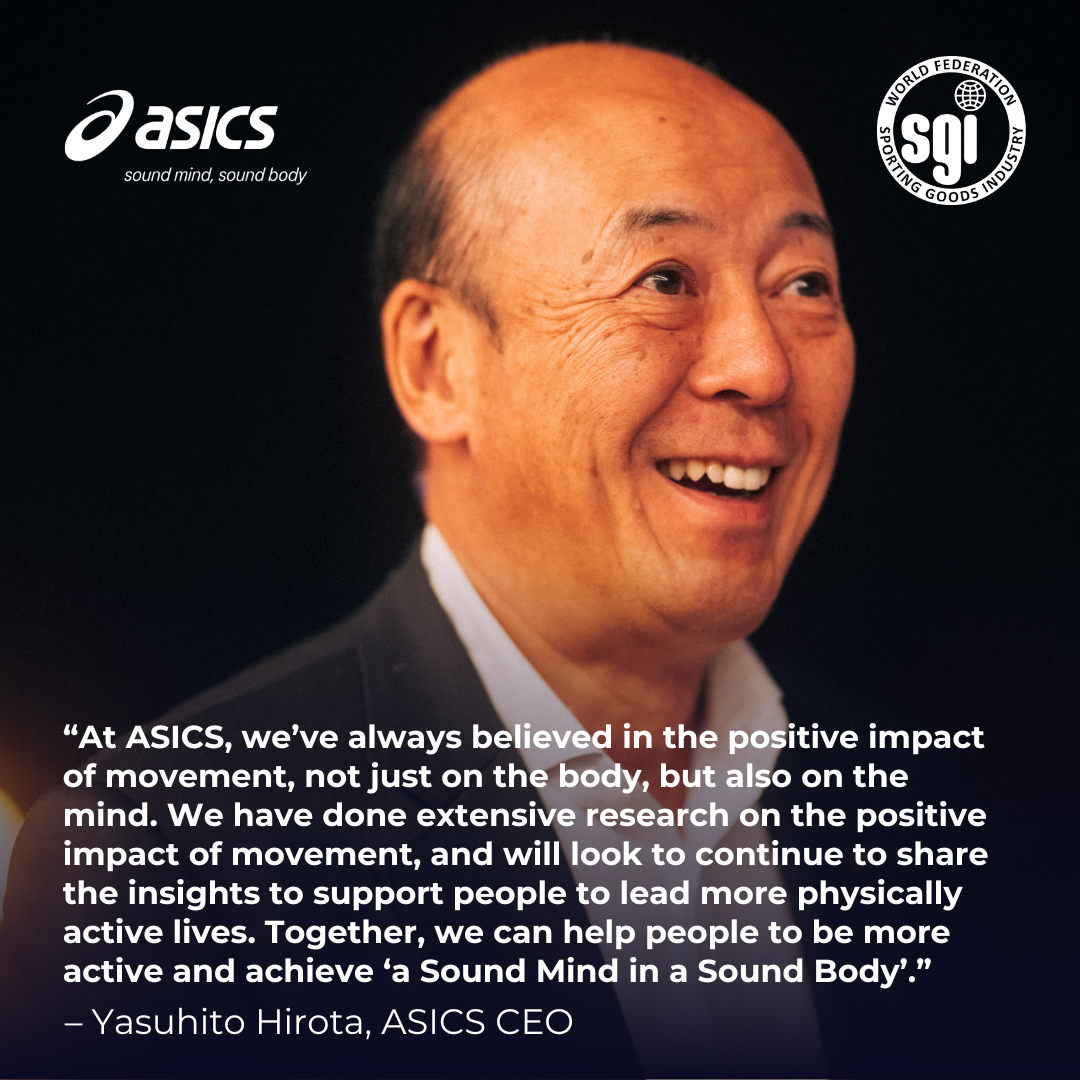


Turn a moment to a movement
In addition to our MOU and the Joint Statement, there is a lot of work ongoing behind the scenes to continue to drive action. WFSGI has a Physical Activity Committee, chaired by Nike, which meets regularly to discuss how the industry can do more. A 2024 summit held in New York, as we discussed how to move from a ‘moment to a movement’ there was evidence of increased interest in our committee and growing demands for ambitious action.
Why is there so much interest from our members? This is often a key question from outsiders looking in! Sporting goods companies recognise they have a part to play to support global policy makers and business leaders to address this issue and it is in their interest to do so – a Win-Win! The decreasing levels of physical activity represent a potentially shrinking industry of customers buying sporting goods but what is particularly concerning is the 81% of adolescents that are not doing enough physical activity to maintain good health. This is the future generation of customers and more significantly, a potential future burden on health and social care systems. More positively, the potential to create a physical activity habit for life amongst these young people represents a significant market growth opportunity for the entire sector.
The hunger to do more
So, what are we doing next? The Joint Statement made commitments to action in four areas; advocacy, community interventions, leveraging the power of major sporting events and partnerships. These four action areas are being aligned with an emerging strategy framework led by our Physical Activity Committee which seeks to drive impact, promote physical activity and fuel change. The very first Physical Activity Impact Report for the Sporting Goods Industry is being prepared and will showcase the best-in-class examples of what our industry is already doing to tackle global inactivity levels. It is hoped this will inspire other members of our industry and others outside it to do more.
WFSGI and Business at OECD new Policy Paper launched
 WFSGI and Business at OECD (BIAC) co-produced a new Policy Paper presented on December 4, 2024 at the OECD Health Forum in Paris.
The paper entitled “Physical Activity: The transversal benefits for our people, our planet, our economy and more prosperous societies,” highlights physical activity as a low-cost, high return investment, benefiting the environment, fostering a healthier workforce, and supporting the development of young people.
It calls for physical activity to be prioritised in and cross-sector collaborations formed to address the intersection of health, economic productivity and sustainability. This multi-sectoral approach, where the private sector can play a more prominent role, positions the sporting goods industry as a key player in shaping innovative and impactful solutions to global challenges.
The bigger the team, the louder the voice
In May this year, WFSGI will host a side event at the World Health Assembly under the topic of Physical Activity: A Strategic Imperative for Health and Economic Prosperity. This event will bring together Governments, business leaders, policy makers and private sector sporting goods companies to raise awareness of the opportunity that physical activity can provide to solve some of our greatest societal challenges of today.
“The WFSGI and its members has jumped into the lead when it comes to convening key sectors to tackling the growing physical inactivity crisis,” explains Dr. Fiona Bull, Head of the Physical Activity Unit at the WHO. “Their knowledge of how and why consumers buy their products and their intended us is vital as we try to get the world to move more. They are an authentic and relatable voice for many young and not so young people around the world and it’s this connection that we feel can help inspire and support good physical activity habits going forward.”
An untapped market for future growth
We touched on what the world would look like if we could improve activity rates. It’s not only a healthier, happier place, it’s also a world where the sporting goods industry continues to grow, continues to build sustainable, successful businesses and innovations for future generations to come.
Find out more:


Reference
- WHO, 2024, Global levels of Physical Activity in Adults – off track for 2030, https://www.who.int/publications/i/item/9789240096905
- WHO, 2024 Physical Activity Factsheet, https://www.who.int/news-room/fact-sheets/detail/physical-activity
- WHO, 2022, Global Status Report on Physical Activity, https://www.who.int/publications/i/item/9789240059153
- WHO, 2024 Physical Activity Factsheet, https://www.who.int/news-room/fact-sheets/detail/physical-activity
- WHO, 2024 Physical Activity Factsheet, https://www.who.int/news-room/fact-sheets/detail/physical-activity
- Coalter, et al (2020). Developing a programme theory for sport and employability programmes for NEETs. International Journal of Sport Policy and Politics, 12(4), 679-697.
- Curative (2024) Seven Reasons Why a Healthy Workforce Improves Your Bottom Line, https://curative.com/blog/seven-reasons-why-a-healthy-workforce-improves-your-bottom-line
- WHO, 2022, Cycling and walking can help reduce physical inactivity and air pollution, save lives and mitigate climate change, https://www.who.int/europe/news/item/07-06-2022-cycling-and-walking-can-help-reduce-physical-inactivity-and-air-pollution–save-lives-and-mitigate-climate-change
Contact

Caroline Brooks
WFSGI Head of Physical Activity
cbrooks@wfsgi.org